Local-vol and PDE validation
Proof path step 3
A smooth Dupire handoff still has to earn numerical trust. This page is the validation argument for the last leg: reprice a representative vanilla bundle, show where the error actually lives, and make the mesh/runtime judgment explicit instead of implied.
The claim is deliberately bounded. The published `101x201` grid is defended for a representative `30`-option bundle, the stressed region remains visible instead of being averaged away, and the convergence sweep shows where extra runtime starts to buy less than intuition might suggest.
Proof routing
Signature evidence
This is the review object for the numerical leg: the scatter shows whether the bundle reprices cleanly, the heatmap shows where the stress clusters, and the convergence/runtime figure shows where extra mesh density stops being an automatic win.
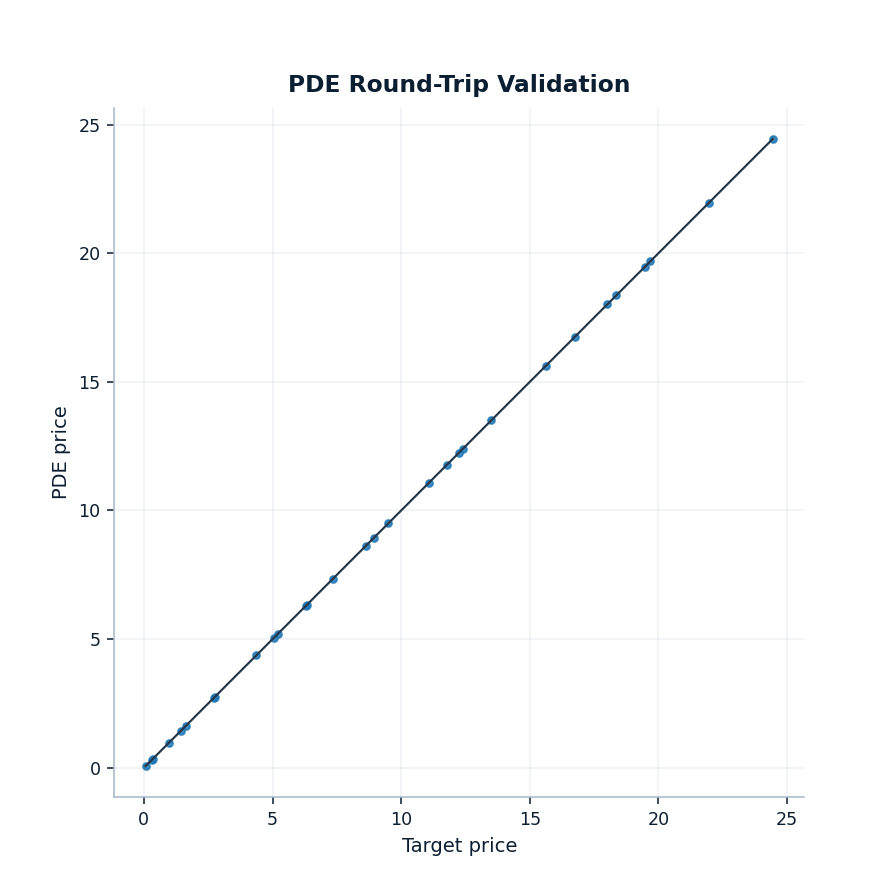
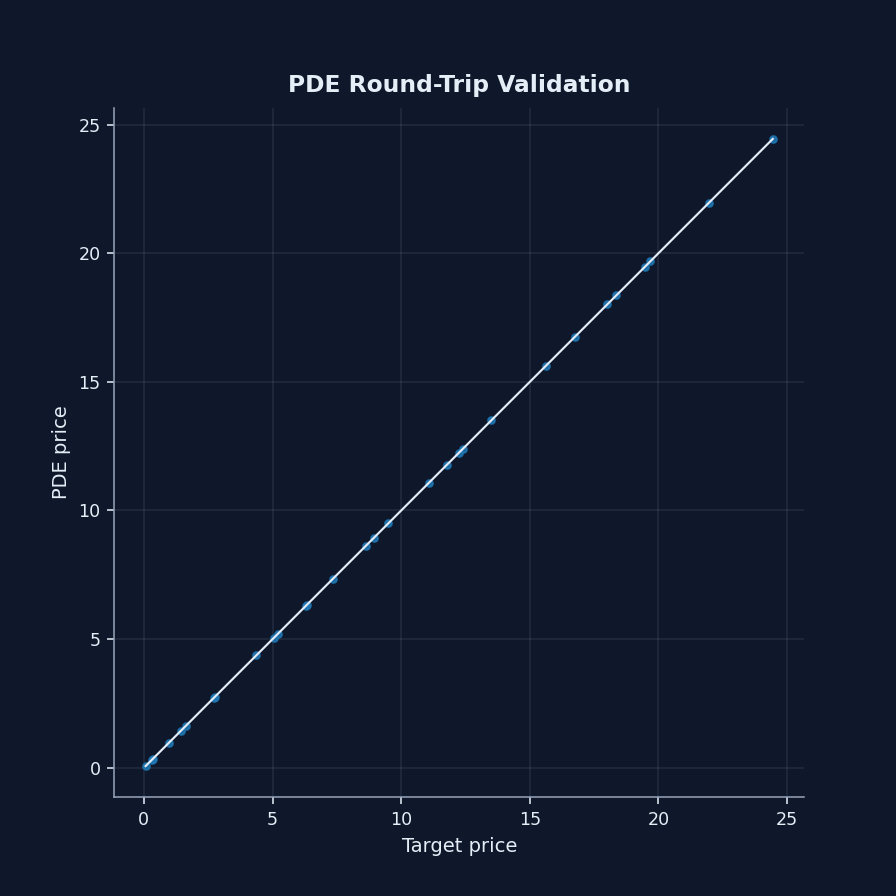
0.0026875, and the worst implied-vol miss stays at 8.2494 bp on the current 101x201 grid.Repricing claim The scatter is the first filter: the local-vol/PDE path reproduces the originating implied surface cleanly enough on the published bundle to be reviewable rather than hand-waved.
Error localization The stress is not uniform. The worst bundle errors cluster around the T = 0.25 strip, so the page keeps strike/maturity structure visible instead of hiding it inside one average.
Runtime judgment The sweep makes the escalation path explicit: keep 101x201 as the published baseline, try 151x301 first when one contract needs more margin, and do not assume that the densest tested grid is automatically the best trade.
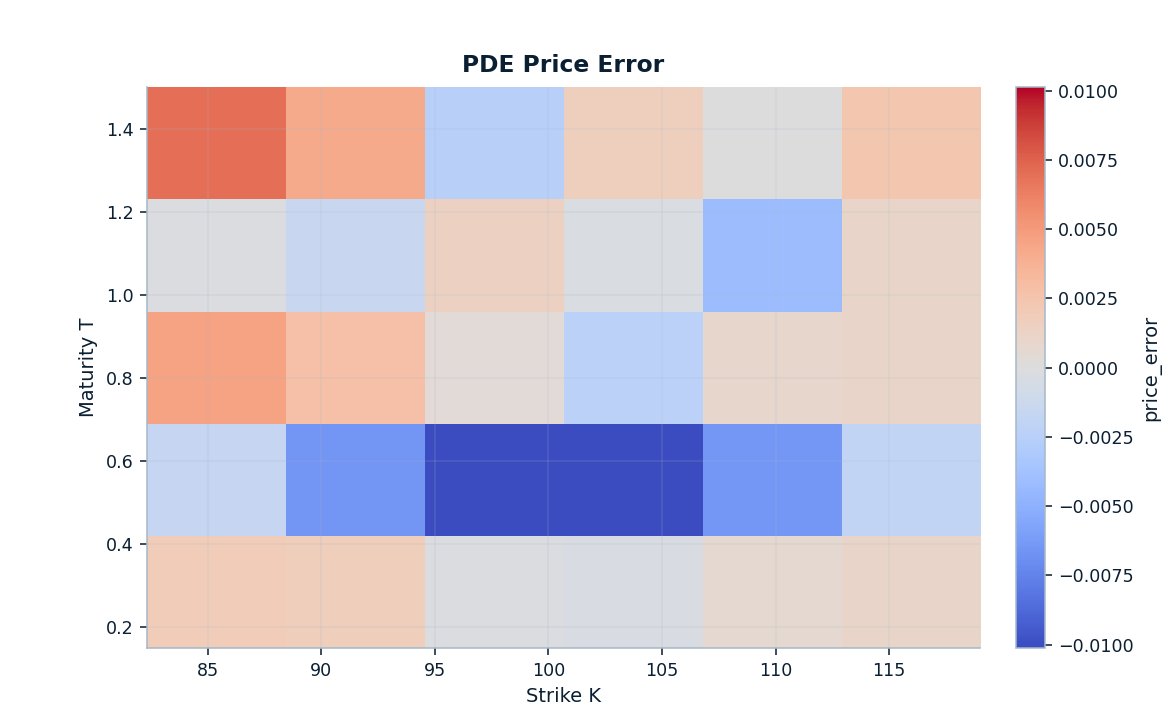
T = 0.25 strip rather than by a uniform bias. That is why the aggregate mean is necessary but not sufficient.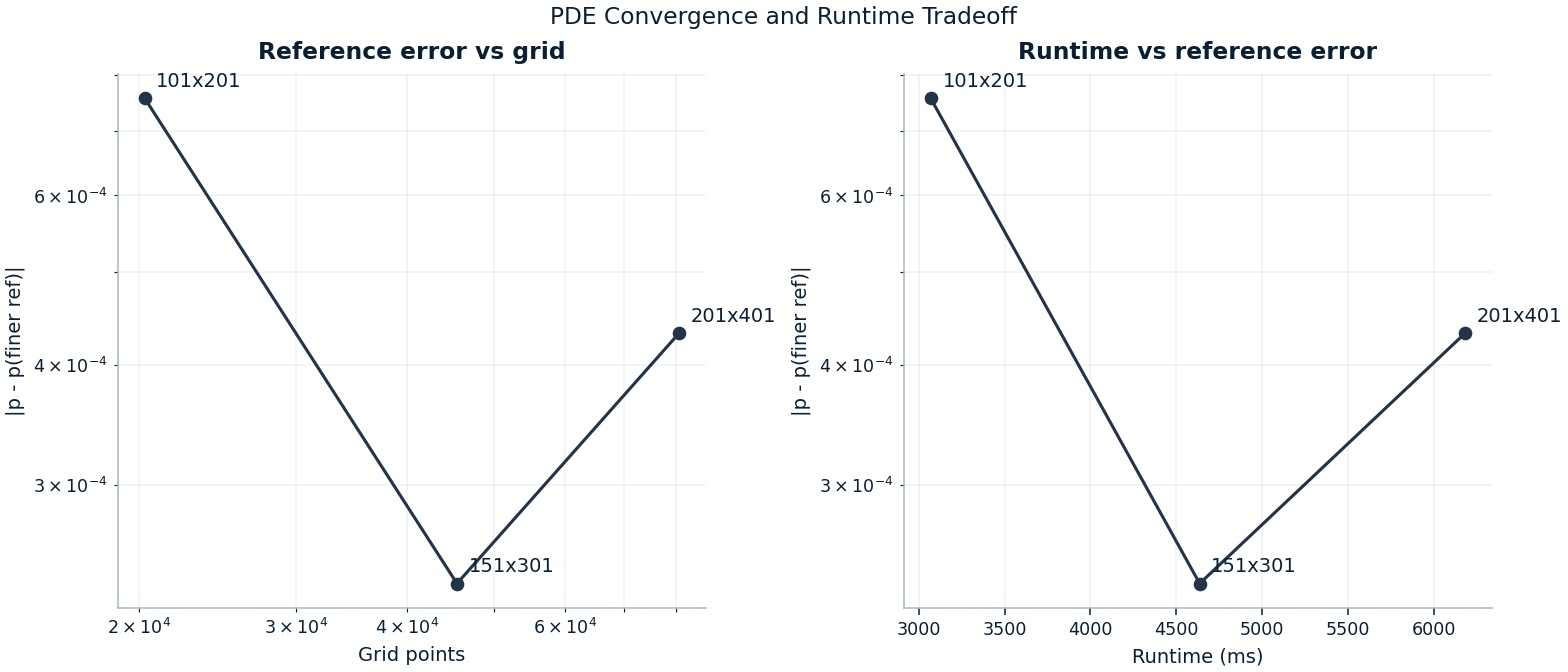
101x201 to 151x301 cuts the representative reference error from 7.57e-4 to 2.37e-4 while runtime rises from 1.03 s to 1.67 s; the denser 201x401 point costs 2.20 s without a further win on this published sweep.Validation claim
The page is strongest when it states exactly what the validation establishes, what it does not establish, and where practical judgment enters.
What this validation demonstrates
The workflow can reprice a representative vanilla bundle on a fixed local-vol/PDE grid, keep the strike/maturity error structure inspectable, and show a credible escalation path when one representative contract needs a tighter numerical check.
What this page does not prove
It does not prove that local vol is the correct market model, it does not make universal claims across every payoff or stress regime, and the convergence leg is judged against a finer-grid local-vol PDE reference rather than an analytic truth for the full workflow.
Where judgment enters
Choosing 101x201 for the published bundle is a practical decision, not a theorem. The page makes the supporting evidence visible and names the first refinement step to try before jumping blindly to the densest tested grid.
Chosen Validation Method
The validation is layered on purpose: start from the explicit smooth handoff, reprice the representative bundle, expose where the bundle is stressed, and judge refinement with a separate single-contract sweep rather than by staring at one default grid.
| Layer | Object or check | Design choice and reason |
|---|---|---|
| Input surface | ESSVISmoothedSurface from the previous step |
Start from an explicit time-continuous handoff rather than a rough slice stack |
| Local-vol diagnostics | invalid masks, denominator checks, worst-point inspection | Keep extraction failure modes visible before making pricing claims |
| Repricing bundle | representative 30-option vanilla-call bundle against the originating implied surface |
Show the numerical workflow where the page actually makes its claim without pretending universality |
| Error localization | repricing scatter plus strike/maturity heatmap | Let reviewers see structure instead of trusting one mean |
| Mesh check | single-option convergence/runtime sweep against a finer-grid PDE reference | Make the grid choice a defended tradeoff rather than a hard-coded habit |
Published bundle result
| Metric | Published bundle value |
|---|---|
| Repriced options | 30 |
| Published bundle grid | Nx=101, Nt=201 |
| Mean abs price error | 0.0026875 |
| Max abs price error | 0.0101152 |
| Mean abs IV error | 1.9422 bp |
| Max abs IV error | 8.2494 bp |
| Mean runtime per option | 943.43 ms |
Numerical judgment
The practical question is not whether a finer grid can reduce error in principle. It is where the current evidence justifies spending more runtime, and where denser meshes stop being an automatic signal of better judgment.
Main takeaway
The evidence supports a layered decision rather than one maximization rule: 101x201 is a defensible published baseline for the representative bundle because repricing stays controlled and the worst implied-vol miss remains in single-digit basis points; when one contract needs more numerical margin, 151x301 is the first refinement worth buying; the denser 201x401 point is not automatically better on this published sweep, so more mesh is not the same thing as stronger validation.
- Use the scatter and heatmap together; aggregate means alone would hide the
T = 0.25cluster that drives the bundle maximum. - Treat the convergence figure as a local decision aid, not a universal theorem. It is one representative contract judged against a finer-grid local-vol PDE reference.
- Use Performance evidence when the question shifts from "is this default defended?" to "how much runtime can the full workflow afford overall?"
- Return to Architecture if you want the system-level safeguard story behind the workflow.